The Chick That Walked Right In
It is almost eight in the evening, and I am pushing a utility cart through the lobby of the United Retailers Center (CUD) with two heavy plastic totes: twenty-four flats holding seven hundred and twenty fresh eggs that we were hauling around because Yari had customer deliveries to drop off immediately following the hackathon. I am lugging fifty pounds of high-protein feed for my silky chickens, three days worth of clothes, and a fully charged laptop. Nobody could comprehend what a farmer was doing with that kind of cargo at an artificial intelligence conference. The organizers stared in bewilderment, but we were not about to ask for permission: we rolled straight in and pitched camp.
Hackathons always change my life. During the crypto fever we founded JibarosNFT, taking the Puerto Rican hill country farmer to the blockchain. We ended up turning into the character ourselves, but with actual dirt beneath our fingernails: moving from Web3 to WebO, which is our word for egg, in case you missed the pun. When the Caribbean AI Summit showed up offering ten thousand dollars in prizes, we had to jump in. That prize money was our only shot at getting a working vehicle for the farm, after ours completely died following thousands of dollars poured into useless repairs. For the very first time I did not need an engineer, because today you build software by simply talking. What I needed was an entrance ticket.
That was our first brick wall. The organizers said no. The best discount available was two hundred dollars, and even on a student rate we could not scrape together a hundred dollars a head. The roster was locked: Greg, the veteran software dev from Lajas; Yari, my beloved co-founder at Punto Pio, an artist who crafts visuals by hand; we were missing a fourth seat. I found Heather on Devpost, a human-centered designer hungry to compete, and I decided right away I would rather have her in my trenches than facing off against her. Just when we were ready to throw in the towel, thinking government agencies might have promo codes, I typed GOV into the checkout box to see what happened. The ticketing platform spat out zero-dollar badges for our entire team. The very next day, right after our initial team huddle, the dreaded email hit: revoked. My pass, dead in the water.
I told Heather what happened. She looked at me and said: if you figure out how to get to San Juan, I will pay your ticket. She laid down two hundred and twenty-five dollars for an internet stranger she had only heard speak during a single video call. That was merely the first link in a chain of human favors that I still struggle to believe actually occurred.
Because the Uber driver who drove us up to the opening event was paying close attention. He overheard our game plan, spotted the towers of egg flats, and turned around at a red light: sounds like you are going to need these fifty bucks this weekend, let me just mark this trip as pending so you can settle with UBER later. We handed him thirty farm-fresh eggs. Share from what little you have, says a proverb I literally made up on the spot, because old folklore knows nothing about poultry.
The marathon kicked off with zero hotel budget and zero cash. I have no bed in San Juan, so that first night I camped out inside Centro Médico: a guy sitting in a hospital corridor with luggage and an open laptop draws zero suspicion from people dealing with genuine human tragedy. In that hallway I spent three uninterrupted hours drafting every specification for Qwida, a platform built so the diaspora living in Orlando or New York can monitor the medical health of their aging parents back on the island. At daybreak, armed with nothing but a twenty-dollar Claude subscription, I put the most expensive model in charge of architectural planning while the cheaper models pumped out raw code. Me, conducting the entire orchestra.
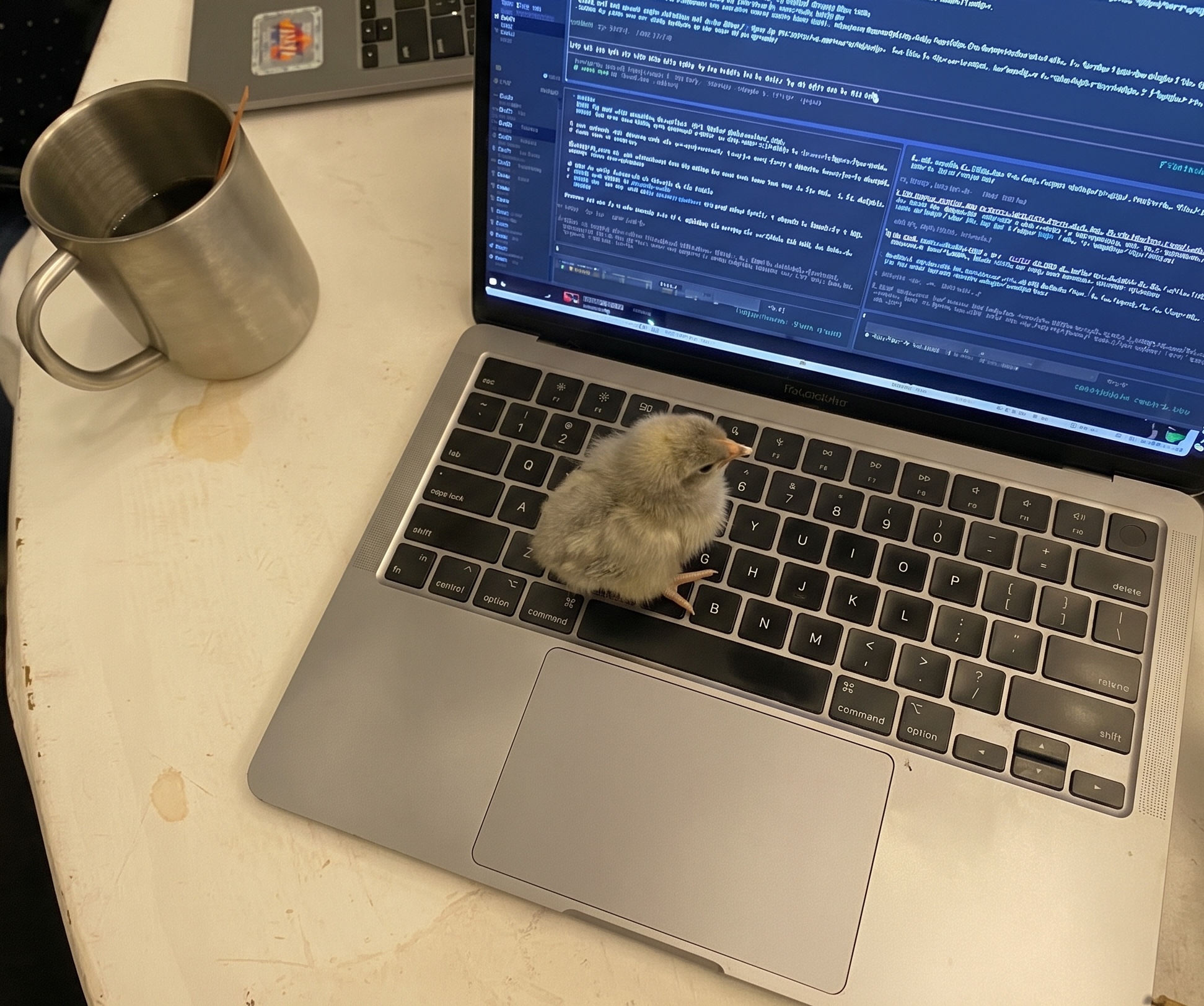
Friday meant twelve grueling hours inside the Puerto Rico Convention Center. There we were joined by a baby chick: tiny, fluffy, newborn son of our farm's patriarch, Mister Posha. He instantly became the undisputed mascot of the summit without paying a cent of admission. We never bothered hiding him: security and attendees welcomed him in without hesitation. The hilarious part is that we actually stressed about smuggling him inside, until the closing ceremony when event organizer JD Torres Quiñones laughed and asked how we managed to sneak a live bird in. We did not sneak him in: he walked right in like he owned the place. In the middle of academic keynote panels debating whether neural networks will steal our jobs, a live chick stole the show. People queued up just to greet the little guy, who took peaceful naps right on our work table before anyone even glanced at our screens. That same Friday we ran into Verushka, a developer with over a decade of industry chops and founder of MedSeek, a verified medical provider directory for Puerto Rico. We hooked her platform into Qwida on the spot: two projects joining hands instead of burning precious hackathon hours reinventing what she had already perfected. The whole day evaporated into shipping clean code. We clocked out shattered, but confident that our creation had a heartbeat.
Second night: the Burger King on Roberto H. Todd Avenue in Santurce, from ten at night until eight the next morning. Police cruisers flashing outside, shady characters peddling illicit deals at four in the morning, zero pocket money to buy a coffee, and barely one hour of sleep curled on Yari's lap while exhaustion threatened to snap our spines. That single hour was the only rest I got the entire weekend.
Saturday morning, back at the Convention Center, the hackathon floor was an absolute oasis for a broke founder: endless complimentary coffee and snacks that kept me on my feet. Even with caffeine flowing, everything felt pushed to the absolute brink: I genuinely began to think I had blood in my coffee rather than coffee in my veins. We poured those remaining hours into refining Qwida and editing the demo video we submitted for evaluation: we never got to pitch live in front of the judges. Our submission highlighted automatic instant prescription OCR, doctor consultations recorded with full patient consent, and an interactive health timeline so overseas families can monitor their elderly relatives like someone tracking a hurricane path on radar.
At two-thirty in the afternoon the axe fell: eliminated. Out of twenty-nine competing teams, only eight advanced to the finals, and Qwida was nowhere on the roster. A brutal, sickening punch straight to the liver. Wandering the halls we ran into other devastated teams: brilliant local builders wandering around in a daze, completely unable to fathom what had gone wrong or what the evaluation rubric had prioritized.
Yari took the baby chick home to rest: our artist and the chick were completely spent. I was running on fumes, but I anchored myself on the concrete curb outside the Convention Center because I refused to leave without understanding why we had crashed out so hard that we could not even pitch. That was when AJ pulled up. He threw me in his passenger seat and we headed to the summit afterparty at Scryer Rum in Old San Juan. AJ had just claimed second place with Roster Planner, a staff scheduling tool born directly from listening to the everyday struggles of his mother, a retired nurse with decades of frontline experience. Over there, Professor Leandro Morales from Polytechnic University, who served on the judging panel, dubbed me Pollito and bought me two stiff drinks. It was there, surrounded by clinking glasses and warm camaraderie, where Judge Leandro gave me the unvarnished breakdown: artificial intelligence complexity was technically optional on the rubric, but the panel inherently rewarded baroque architectures tackling convoluted problems. We had leveraged simple, practical tools to heal an everyday human agony. It was not a lack of hustle: we chose to address human pain in an arena that celebrated technical pyrotechnics.
Around one in the morning, nodding off in a leather lounge chair, John, a familiar pillar of the venue, tapped my shoulder: buddy, how are you getting home tonight? I gave him the raw truth: my pockets are empty, my Uber account is in the red, and I have no clue how to reach Manatí. He unlocked his phone, entered my rural farm address, and dropped fifty-five dollars out of his own pocket for my ride home. He refused my offer of eggs. His only condition was crystal clear: whenever you see someone else drowning, pay it forward.
On that ride back west I had a Dominican Uber driver with an unbelievable sense of humor. I nearly broke down in tears in the back seat recounting every single blessing and act of generosity that had carried me through those forty-eight hours, and the sheer grace of making it back to the soil before dawn.
I kicked off my muddy boots inside the tent where I live alongside the birds and crashed for twelve uninterrupted hours. The next afternoon, with a rested head back on the farm, the fourth link in this chain took shape. I could not stomach the thought of twenty-five eliminated teams heading home convinced their sweat and intellect were worthless. I am nobody to judge anyone, but the panel had written extensive private evaluations and nobody was translating that critique with empathy. I spun up several language models to digest that official feedback, generating clean, constructive summaries for every eliminated team breaking down what the judges truly saw: their real strengths alongside the technical gaps that cost them the cut. It was never about preaching; it was about lifting the spirits of the people who shared our trenches. We fight hard in competition, but our true mission is lifting Puerto Rico together.
Our farm stands, but we remain without wheels, and on foot eggs cannot reach customer tables nor can feed bags reach the coops. I am not writing this chronicle to pass around a church collection plate, nor to sugarcoat a loss: we lost the hackathon, plain and simple. But if after reading this wild ride you believe in what we are cultivating and want to help Punto Pio keep fighting the good fight for Puerto Rico, help us put our farm back on wheels through our GoFundMe. As for the chick, he has already learned how to walk right in on his own.